
How to Study Effectively in a Sustainable Way!

Hi Dear Readers!
When you are a student most of the hours in your day are dedicated for studying. But on top of being a student, there are many other areas that we want to put our time into. Hanging out with friends, establishing a social life with our fellow study mates, part time work, hobbies, just to name a few. So, to free up some time in your schedule for all your other activities, you can optimize the hours you spend on studying. So here I give you a few ideas on how to study more effectively in a sustainable way, having spend hours studying from middle school to university.
Remember, this post is written purely on personal experience. Only take what resonates with you from this post and leave the rest. You are on your own journey, and only you know what the best for yourself is.
Schedule Your Time
If you often find yourself doing anything but studying when you need to study, scheduling your time could be a good idea. It could be regardless, as it will give you an overview of commitments. By structuring your time properly, you get an understanding of how many hours you have in your day, and what time scheduling will work the best for you. You also limit the amount of ‘wasted’ hours, by figuring out when you are the most productive in the day.
If you want some ideas on how to structure your studying, check out my blog post on How to Sustainably Structure your time as a Student
Try out Different Reading Methods.
Since it is hard to find one study technique that fits every single course, or whole degrees for that matter, I suggest you try different ones out. I will present a few ideas here but note that they may not be applicable to your specific situation. The amount of reading methods is not limited to these ideas.
Overview Method.
If your course/degree has a very heavy reading burden, for instance with history class or with a law degree, then this study method may be for you. I was suggested this way of studying by my professor in history, and I found it very effective. The idea with this reading method is to get a general overview of your topic, paper, etc., to get an idea of the text. This means that you only read the titles, table of contents, abstracts, chapter headings, conclusion and tables etc.. This allows you find out the difficulty of the source and whether it is useful without investing a lot of time.
You would not use this method if you, for instance, wished to get a deep understanding of your source, were specific details are important.
Selective Reading.
I used this reading method a lot when I studied International Business Communication, where the reading load could be quite significant. Selective reading means that you are reading your source with the intention of finding specific information. Here you don’t read the entire source(unless relevant in some way), but instead read certain sections to find the desired information. This could be specific words or terms that are particularly relevant to your project, or to understand your topic better.
You would not use this method if you were trying to, for instance, get a feel for the language, difficulty, etc., of the source. It could potentially be confusing if the type of source is not what you are looking for.
Intensive Thorough Reading.
You use this method if you have found exactly the information you a looking for at want to learn/know the contents in depth. This means that you read the source “word-for-word” to find concrete and precise information that you with to know to your core and would be able to recite certain aspects. If you are writing an academic paper or doing a specialized presentation, where you need to know your main source(s) extremely well, this would be an ideal study method.
You would not use this study method if you are trying to for instance, get a general idea of your source, as it could potentially waste to much time if it’s not a source you can use.
Organize Your Notes
Starting off, if you are not the type of person to write notes, I think it’s a good idea to start. You don’t necessarily need to review them again later. But just having had the information you wish to learn “through your finger”, through writing notes, will help you remember the information later. Notes can be done both physically both also on your computer or laptop. But in the end, it is of course up to you whether you want to or not.
If you do write notes, you will do yourself a huuuuuge favour to spend some time organizing them. Even from the beginning of your course/semester. This will make it easier for you to find the relevant notes later and review them for your exams. If possible, start from the beginning of the year/semester to save yourself time doing it in the exam period. A very effective way to organize your notes can be the following:
Binders 
Using binders, you can divide your notes into their corresponding classes/courses. Here you can further subcategorize your notes into all the themes/topics/books/etc. that you have/will cover in your studies. Going the extra step to have a separate binder for each semester/year, will make it easier for you to keep track on your notes and avoid cluttering. Use different colours for each semester/class to make it more aesthetically pleasing
 Post-It Notes
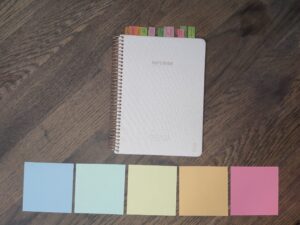
Make it easier for yourself to find specific information in your books/sources again by using post-it notes or sticky notes. As you can see on the photo, marking the exact pages that are significant to your project, paper, etc., will make it easy for you to look up. Then you save time flipping through the pages or looking for specific key words in the back of your book(that may not even be there). Also, here you can use different coloured post-its depending on the information you wish to save. For instance, key words, quotes, tables, chapters, etc.. This can also be used as an alternative to taking notes and pairs well with highlighters.
Highlighters 
Using highlighters are similar to using post-its, however somewhat less versatile. You would use highlighters to overline very specific words, explanations, quotes, paragraphs, etc.. You would however still need to flip through the book to be able to find the information highlighted, which can be difficult. To fix this shortcoming, you can with benefit use highlighters along with post-it notes.
As with anything else in the world, try out what works for you. Not every study method, note taking, etc., works for every class, course, degree and so on. Share in the comments which study methods you use. They could help a fellow student out there in the world.
Did you find this post interesting or useful? Please share it with your family and friends and give it a like. I appreciate it!
♥!CHECK OUT MY OTHER BLOG POSTS BELOW!♥
♥WANT TO JOIN MY COMMUNITY OF FELLOW PASSION SEARCHING AND CONSCIOUS LIVING INTERSTED YOUNG ADULTS?♥
Follow me on my social media!
♥WANT TO KNOW MORE ABOUT THE AUTHOR BEHIND MIE HOLM?♥
About Me How to Study Effectively in a Sustainable Way! How to Study Effectively in a Sustainable Way! How to Study Effectively in a Sustainable Way!



A good reading metod I have found while studying Lingiustics teaching is mainly for academic papers and longer academic texts, it is in the simplest form look at the abstract of the paper and the conclusion for general results. And if needed go to the specific sections for formulars.
Ps. Love the blog <3
That’s an awesome tip! Saves a lot of time too which can be a lifesaver during exam periods. Thank you for sharing!♥ And thank you so much for following my blog!♥ I really appreciate your support! Let me know if there is any topics you would like for me to cover (:
Anything you may find interesting to discuss or bring to light! It is always quite interesting to see your view on things and how varied it might be from my own!
Awesome, I will definitely keep that in mind! Thank you for your input!♥ (: